Features

Everything the harness does

The models are the commodity — you can use any of them, and they get better every month without us doing anything. What matters is what sits around them.

Write a chapter at a time

Prompt, stream, revise, accept. The loop is deliberately small, because a novel is not written in one shot — it is written a scene at a time, with a judgement call after each one.

Drafts stay drafts until you accept them. Revise in plain language as many times as you want, or open the text and rewrite a line yourself. Nothing is locked and nothing is thrown away without you asking.
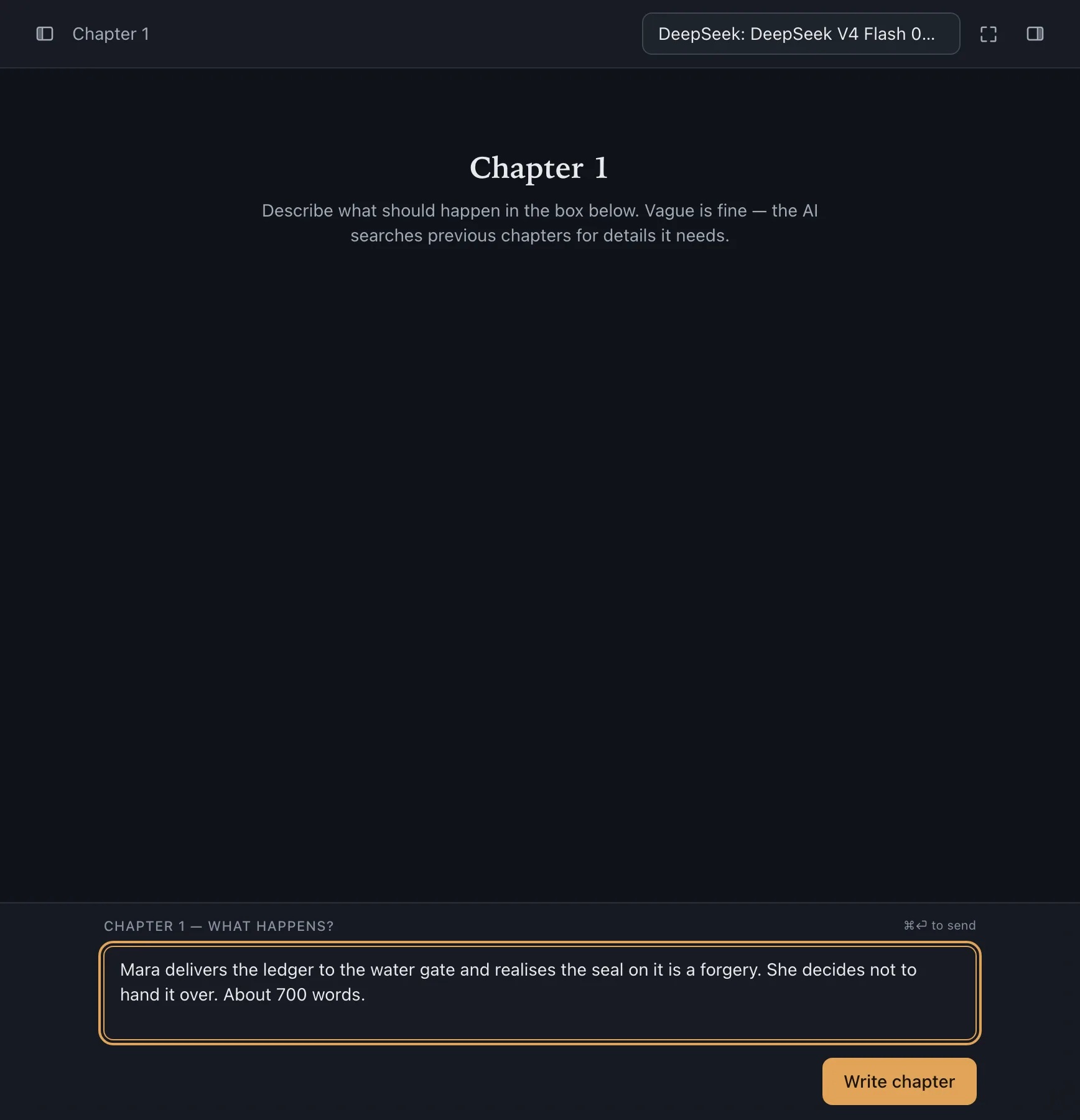
The prompt composer with a chapter instruction typed in.

Memory that survives 200 chapters

Every chapter is written with the previous ones in hand — the real text, not a paraphrase. Once that history outgrows a 60,000-token budget, the oldest chapters collapse into dense summaries written at the moment you accepted them, exactly the way a coding agent compacts a long session.

The full text never disappears. When the model is unsure who someone was or what was agreed in chapter four, it searches your earlier chapters mid-draft and reads the passage before continuing — and you can watch it happen.

The context panel showing a retrieval trace and chapter provenance.

Six ways to sound

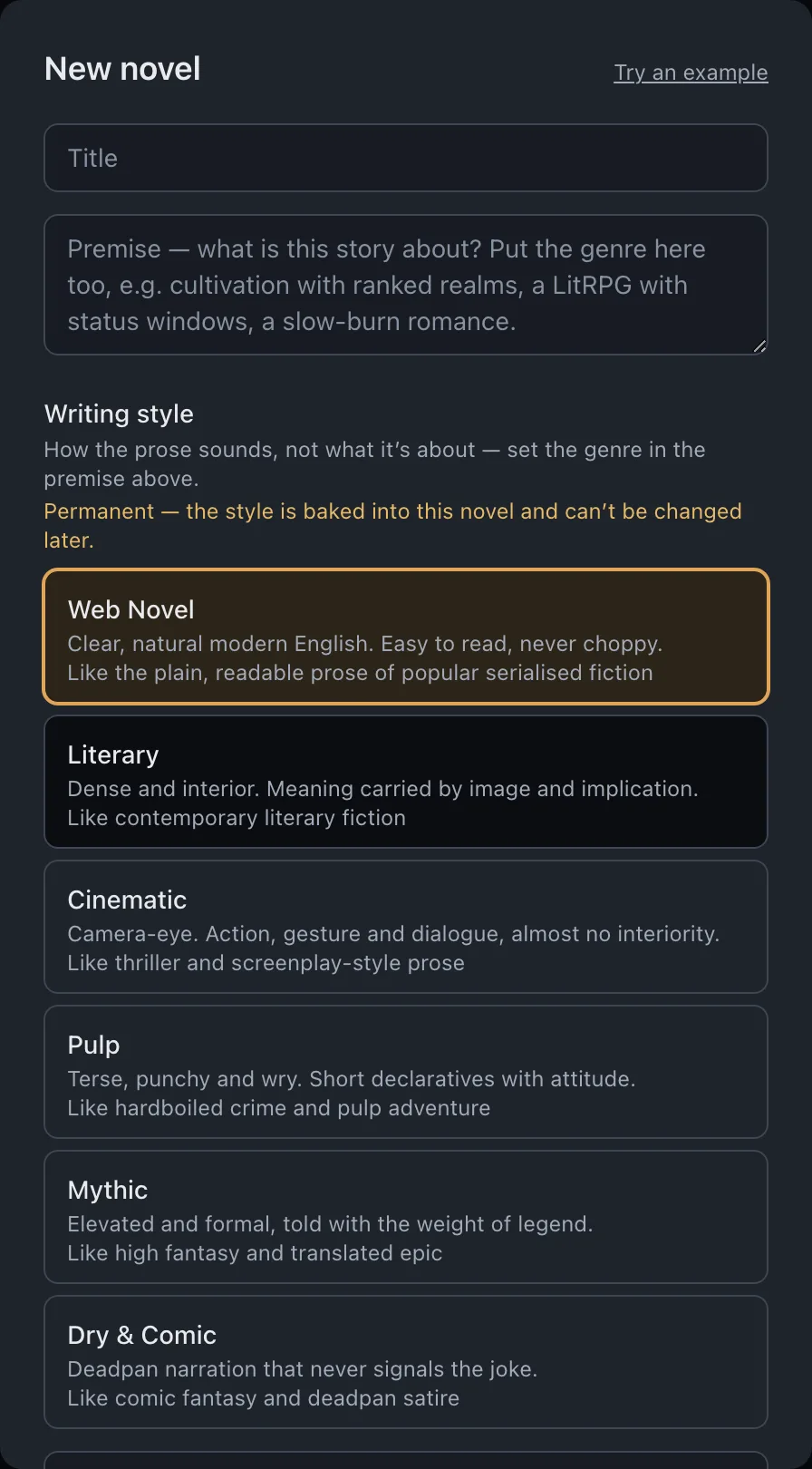
Style here means the prose register, not the genre: web novel, literary, cinematic, pulp, mythic, and dry comic. Genre belongs in your premise — a cultivation story can be told in plain serial prose or in an elevated mythic voice, and those are genuinely different books.

Each register is a set of concrete mechanics — sentence length, paragraph shape, how much interiority, how figurative — rather than adjectives about tone. Set once per novel and held for its whole length, so chapter 90 sounds like chapter 1.

The style picker showing the six writing styles with descriptions.

Any model, through your own key

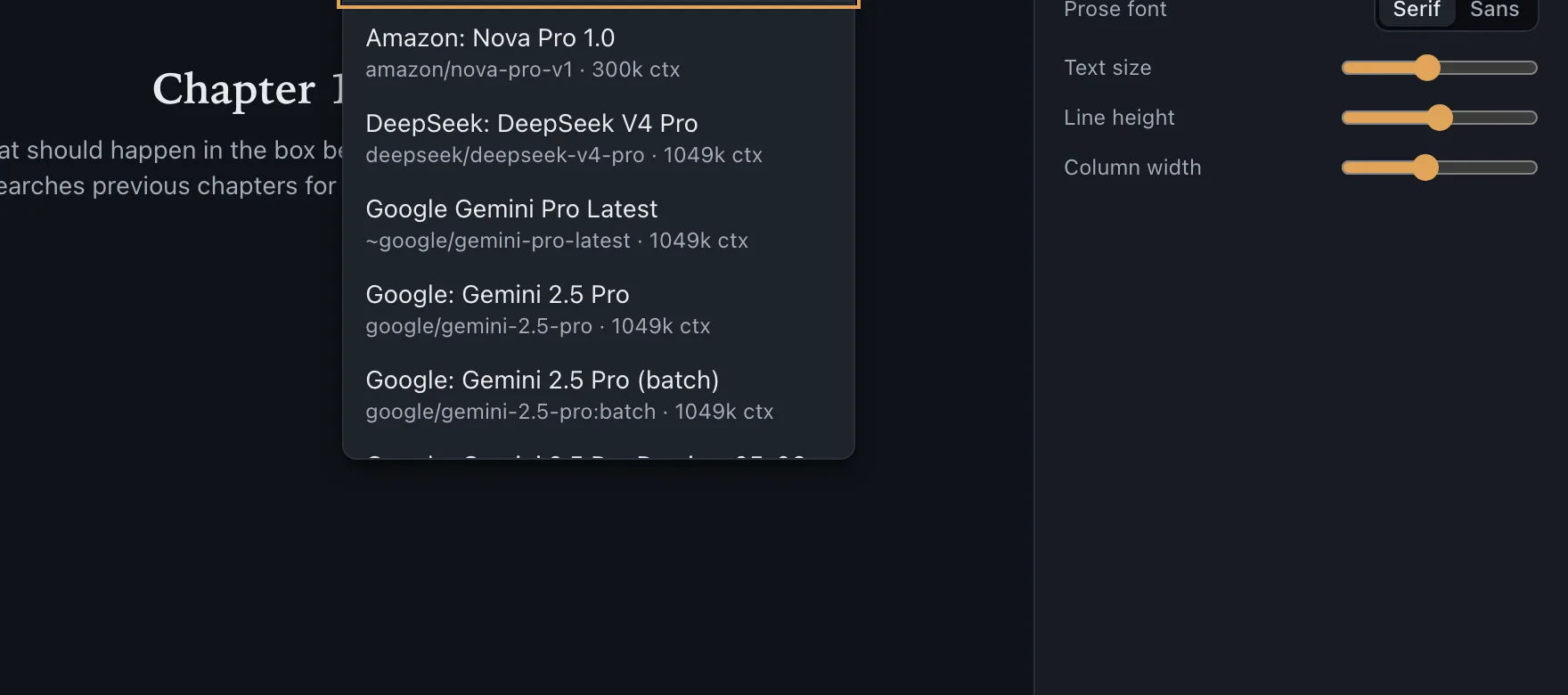
Over 400 models via one OpenRouter key, switchable mid-novel. When something better launches you get it the day it lands — no waiting for us to integrate anything.

Providers are pinned per model rather than load-balanced, which sounds like a detail and is worth real money: a scattered request loses its cache and pays full price for the whole novel again.

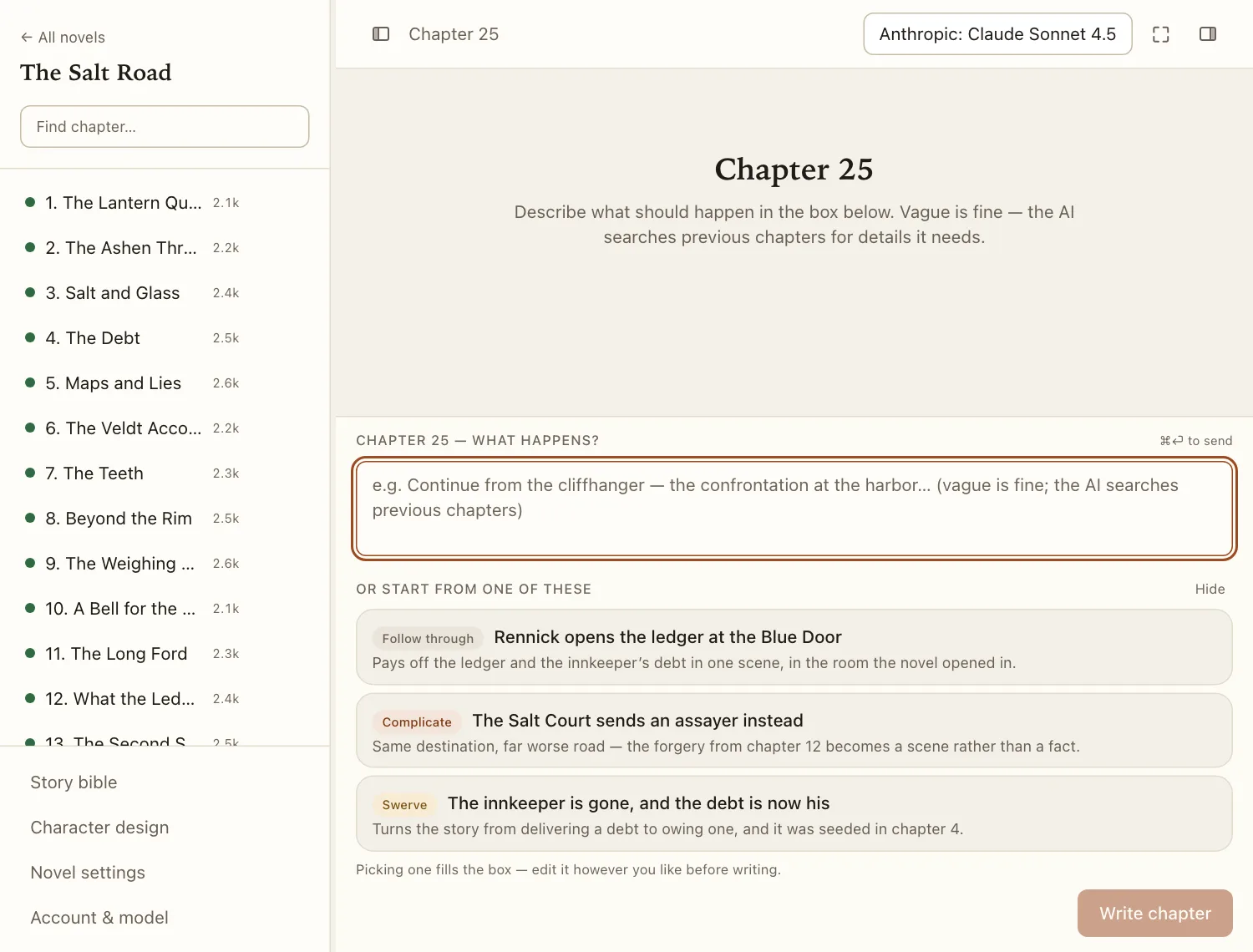
The model picker open, showing recommended models and a search box.

Caching that actually lands

Chapters are appended, never rewritten, so the prompt for chapter 40 begins with exactly the bytes that chapter 39 sent. Providers can reuse that prefix at roughly a tenth of the price — which is the difference between a novel that gets more expensive every chapter and one that does not.

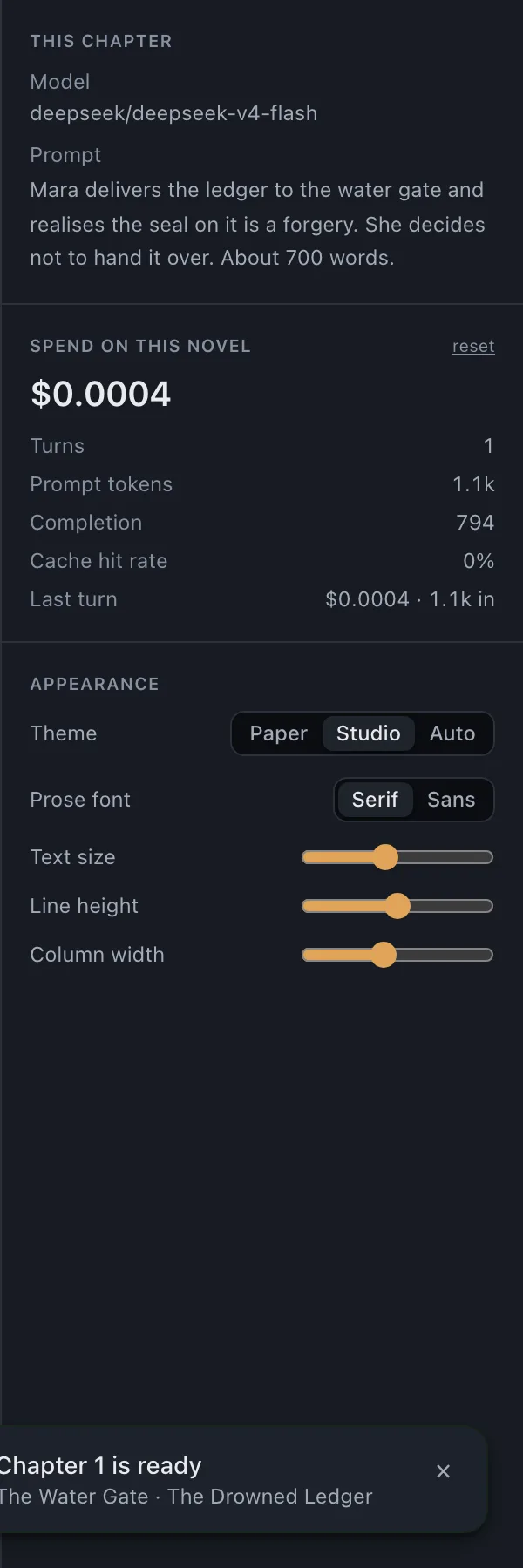
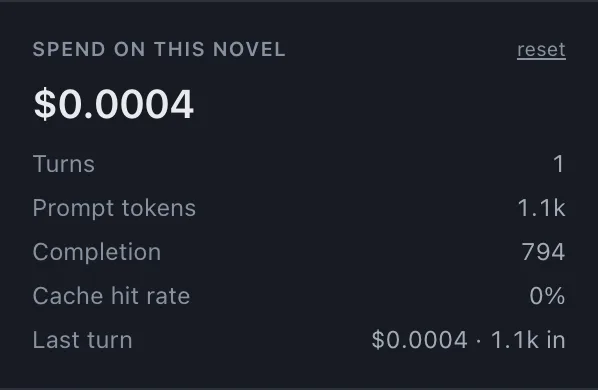
It is measured, not assumed: the app shows the live hit rate per novel, and the estimator models it honestly, including the models that quietly do not support it.

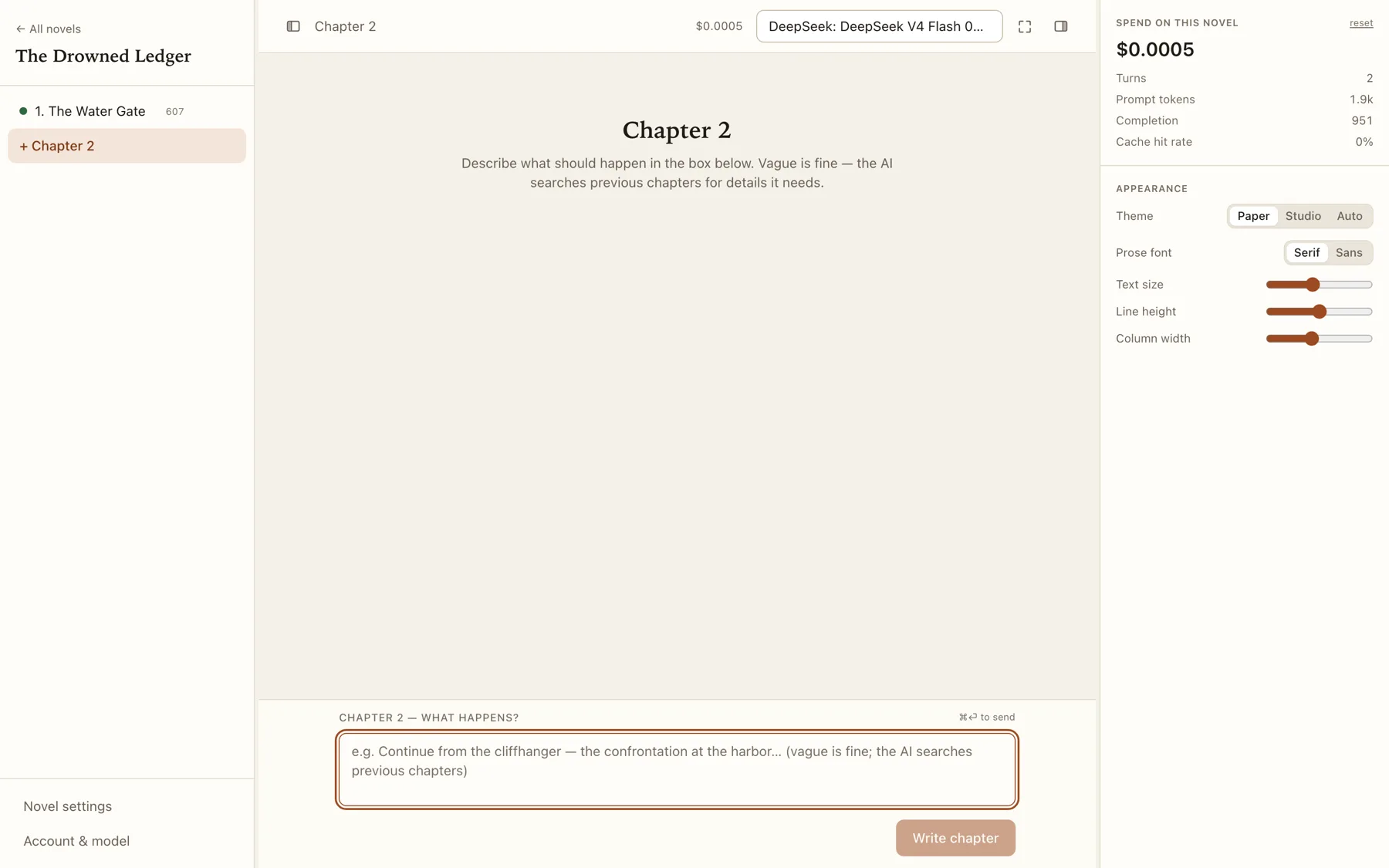
The spend panel showing total cost, tokens and cache hit rate.

A workspace built for long sessions

Three resizable panes — chapters, prose, context — that collapse when you want the page to yourself. Focus mode hides everything but the words. Two themes, plus separate reading settings for the prose column: serif or sans, size, line height, column width.

A command palette on ⌘K, keyboard shortcuts for the whole loop, and generations that keep running when you navigate away and tell you when they are done.

The writer in the light Paper theme with all three panes visible.

Your text is yours

Export any novel in full whenever you like. Delete a chapter, a novel, or your entire account — and deletion means deletion. We do not train on your writing, and we impose no rules of our own about what your story is allowed to be.

Hidden novels sit behind a PIN, off your dashboard and out of exports until you unlock them.

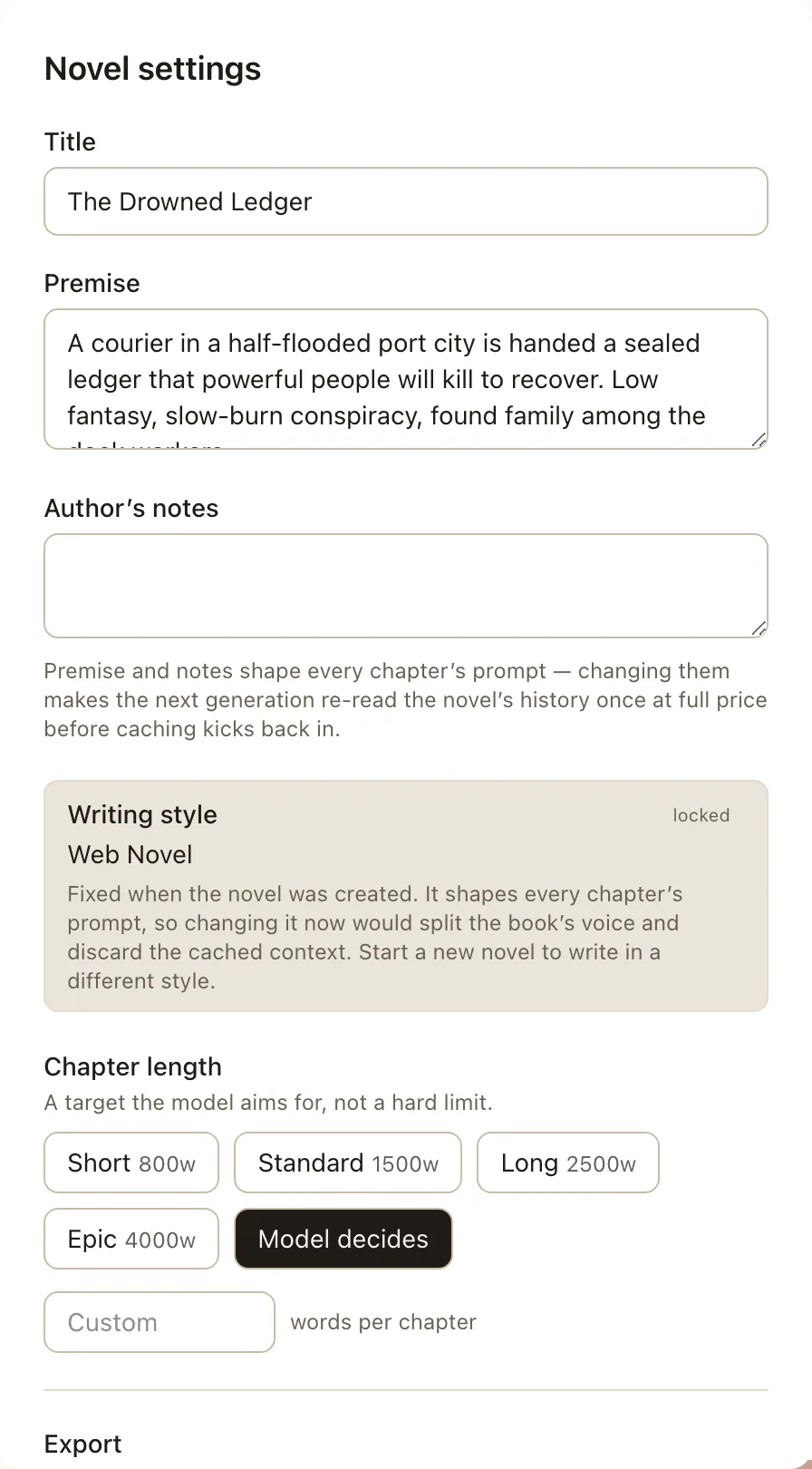
Novel settings showing export and delete options.

Coming soon

What comes next

This is a harness, and a harness is never finished. Here is what is being built, roughly in the order it is coming.

01Planned

A desktop app

The same harness running on your own machine, the way Codex and Cursor do for code. Your novels stay in a folder you own, on a disk you control — nothing leaves the computer except the model call itself.

02Planned

Fully local, fully private

With the desktop app, storage becomes yours. Point it at a local model and a novel can be written end to end without a single word leaving the machine — the strongest privacy guarantee there is, because it does not depend on trusting us.

03Planned

Publish straight to your blog

One-click publishing to WordPress, Ghost, Substack and a plain RSS/Markdown export, so finishing a chapter and putting it in front of readers is the same action.

04Planned

A reader, for reading

A proper reading view for your own work and for anyone you share a novel with: continuous scroll, chapter navigation, bookmarks, offline. Writing something nobody can comfortably read is only half the job.

05Planned

Serial publishing tools

Schedule chapters ahead, keep a backlog, and post on a cadence — the discipline that actually builds a web novel audience, without a spreadsheet.

06Planned

Outline and arc planning

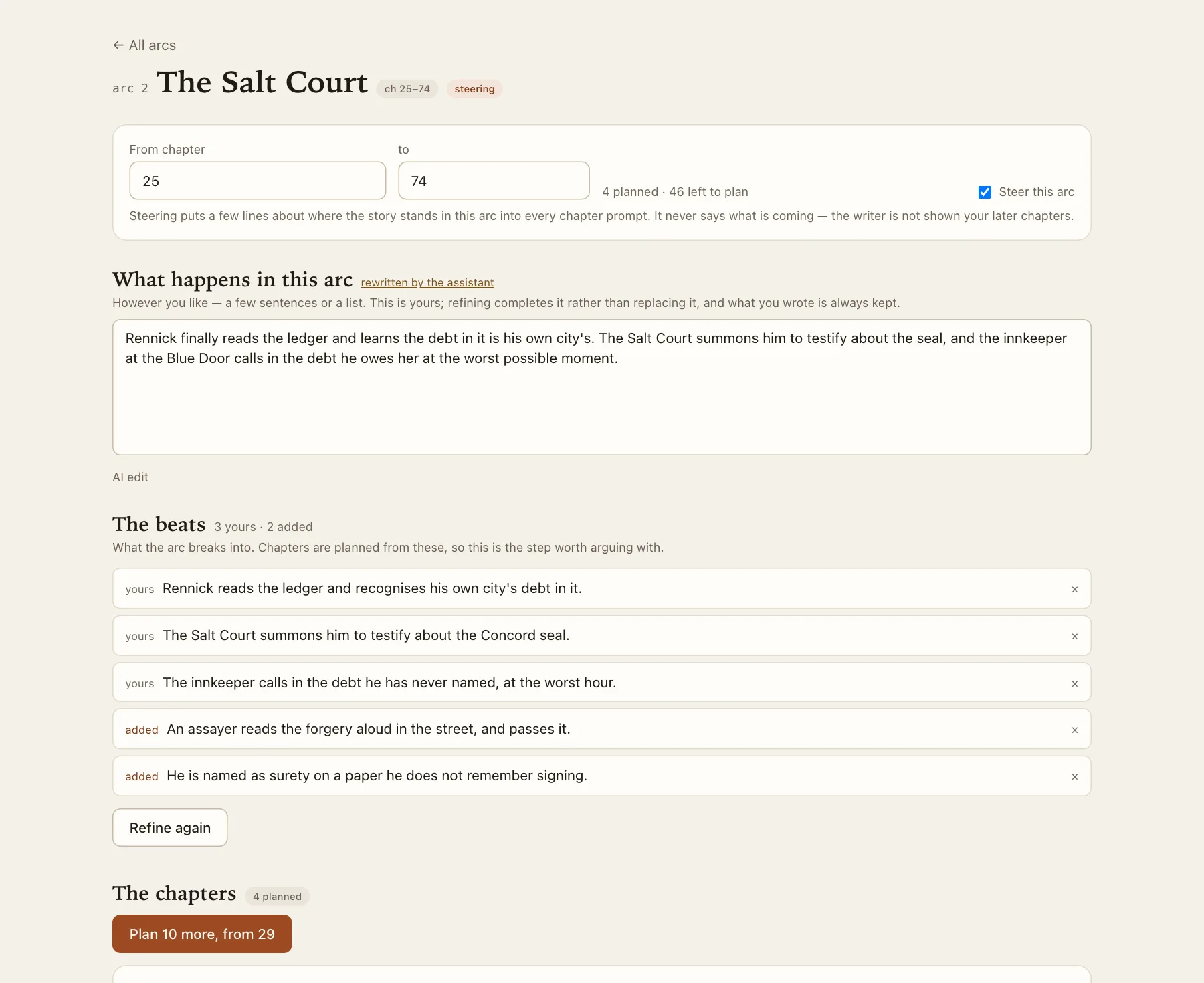
Sketch the shape of a book before writing it: arcs, beats, where threads open and close — then have the harness write toward that plan instead of drifting.

07Planned

Continuity checking

An automatic pass that reads a new chapter against everything before it and flags contradictions: a changed eye colour, a broken world rule, a character in two places at once.

08Planned

Multi-model chapters

Draft with something cheap, polish with something excellent, and pay the premium only where it shows. The harness knows which call is which.

09Planned

Voice and audiobook export

Turn accepted chapters into narrated audio, because a large part of serial fiction is now listened to rather than read.

10Planned

Translation

Serial fiction crosses languages constantly. Keep names, terminology and the prose register consistent across a whole translated novel rather than chapter by chapter.

11Planned

Cheaper models, better results

Continuous evaluation of what is genuinely good for fiction at the low end. When a model an order of magnitude cheaper writes just as well, you should be the first to know.

12Planned

Inference optimisation

More aggressive caching, smarter compaction, fewer wasted tokens per chapter. Every improvement here comes straight off your bill.

No dates promised — things ship when they are good rather than when they are announced.

Start your novel

Bring an OpenRouter key and write chapter one in the next five minutes.