Why we built webnovellm
For people who have the imagination but not the articulation — a harness for writing web novels, with the model choice and the money left in your hands.
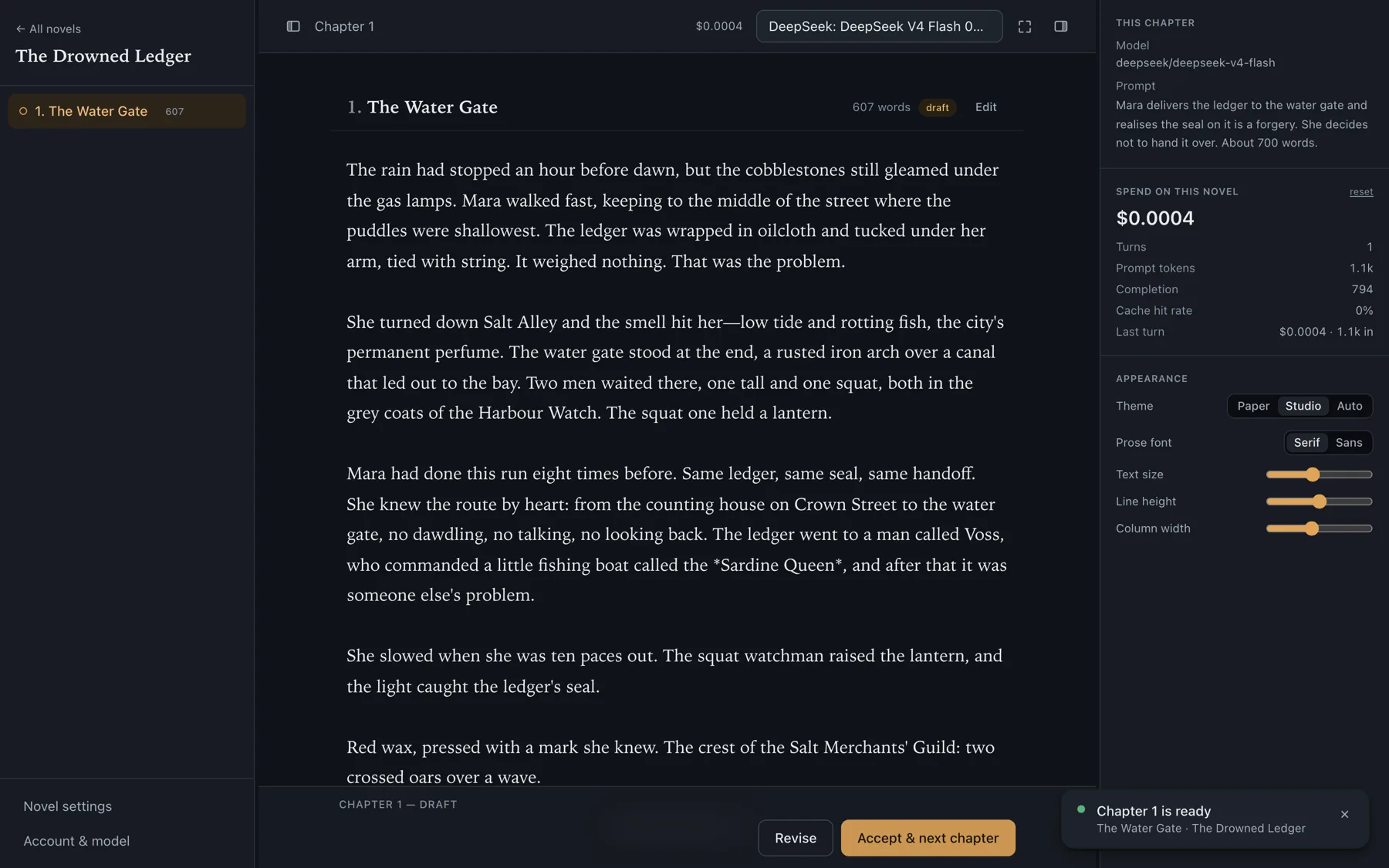
Most people who want to write a novel never finish one. Not because the story is not there — often it is completely there, vivid, argued over on long walks, carried around for years. What stops them is the distance between having the story and getting it onto a page: three thousand words at a time, four hundred times, each one of them a sentence that has to be constructed.
That gap is the whole reason this exists.
Imagination is not the bottleneck
There is a particular kind of person we built this for. They can tell you exactly how the cultivation realms in their world work, why the sect elder betrayed the protagonist's father, and what the ending is. They have the imagination. What they do not have is the patience, the training, or the eight hundred hours it takes to turn that into prose that reads well.
For a long time the only answer was: learn to write, or don't. That is a good answer if you want to be a writer. It is a terrible answer if you want to have written — if what you actually want is for the story in your head to exist where other people can read it.
Models are now good enough to close that gap. Not to replace the author — someone still has to decide what happens, notice when a scene is flat, and know that the ending is wrong. But good enough that "I can see it but I can't write it" stops being a full stop.
A harness, not a chat box
Here is the thing that took us a while to accept: the model is not the hard part any more.
Coding worked this out first. GPT-4 could write a function long before anyone could ship a feature with it. What changed was the harness around the model — Claude Code, Cursor, Codex — tools that knew what your codebase was, could search it, could hold a long task without losing the thread. The model was the commodity. The harness was the product.
Fiction has the same shape and almost none of the tooling. Drop a web novel into a chat window and by chapter thirty it has forgotten your protagonist's sister's name, the rule you set for how magic works, and the debt somebody owed in chapter four. Not because the model is stupid, but because nothing is feeding it the right things at the right time. That is a harness problem.
So that is what this is. A workspace that:
- writes one chapter at a time, because that is how serial fiction is actually made — prompt, read, revise, accept, continue;
- carries the previous chapters in full, and when they no longer fit, compacts the oldest into dense summaries rather than dropping them;
- searches your own novel mid-draft when it is unsure who someone was, instead of inventing them a second time;
- holds a prose register for the whole book, so chapter 90 sounds like chapter 1;
- and pins providers so prompt caching actually lands, which is the difference between a novel that gets more expensive every chapter and one that does not.
None of that is glamorous. All of it is the reason a novel written here still makes sense two hundred chapters in.
The best models, and never the last one
We do not train models and we do not intend to. Every one gets meaningfully better every few months, and the day a better one ships you should have it — not whenever we get around to an integration.
So the tool talks to OpenRouter, and through one key you get four hundred models: DeepSeek, Gemini, Claude, GPT, Grok, GLM, and whatever lands next month. Switch mid-novel. Use something cheap for the filler chapters and something expensive for the climax. The harness improves, the models improve underneath it, and neither is waiting on the other.
Free to use, and honest about what that means
The app is free to use. Every feature, every model, every novel — no trial and no subscription.
That is possible because we do not run the models. You bring your own key and pay the provider directly at wholesale rates, and we never touch the money or take a cut of it. It also means the economics are yours to control rather than ours to average out:
the one place you should have real freedom is the money. A chapter can cost you a fraction of a cent or ten cents. That is a choice about how much the prose matters to you on this particular chapter, and it is not a choice a subscription lets you make. So we show the running cost of every turn while you write, we work to shrink it, and we built a calculator that tells you what a whole novel will cost before you start — including the models where caching quietly does not work, because that is worth real money and nobody else will tell you.
No rules about what your story is
We do not impose content restrictions. Not out of edginess — because it is not our place. What you can write is between you and the model you chose, and every provider has its own policies, which differ enormously. If one refuses your story, pick another one. Our own rules cover only what is illegal or abusive.
Your text is yours, too. We do not train on it. Export it whole whenever you like, delete it and mean it, and hide a novel behind a PIN if you would rather nobody knew it existed.
What is coming
The harness is early. The biggest thing being built is a desktop app — the same workspace running on your own machine, the way Codex and Cursor do for code, with your novels in a folder you own rather than in our database. Point it at a local model and a whole novel can be written without a word leaving your computer. That is a privacy guarantee that does not require trusting us, which is the only kind worth having.
After that: publishing integrations, so finishing a chapter and putting it on your own blog is one action rather than a copy-paste ritual. A proper reader, because writing something nobody can comfortably read is only half the job. Scheduling and a backlog for serial releases. Outline and arc planning, so the harness writes toward a shape instead of drifting. Automatic continuity checking. Cheaper models continuously evaluated, and inference optimisation so every improvement comes straight off your bill.
The point of those pieces is not the pieces. It is a system that knows your book, gets it written, and then gets it read.
Start
If you have a story you have been carrying around for years, it takes about five minutes to get the first chapter of it out of your head.