What writing a novel with AI actually costs
Sudowrite, NovelAI, NovelCrafter, ChatGPT and Grok compared on the number none of them make simple — what a hundred chapters actually costs.
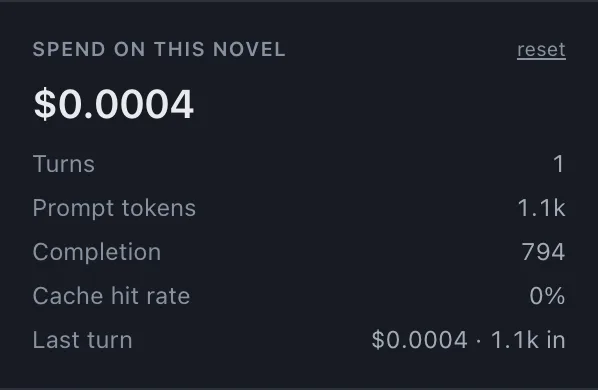
Every tool for writing fiction with AI will tell you what it costs per month. Almost none of them will tell you what it costs to write a novel — which is the only number that matters, because a web novel is not a month of work. It is a hundred chapters and a year.
So here is that comparison, with prices checked on 10 August 2026. They change; check them yourself before you commit to anything, including us.
Three ways to be charged
Strip away the branding and there are only three business models here.
A subscription with credits. You pay monthly for an allowance of generation. Sudowrite runs this way: Hobby & Student at $10/month for 225,000 credits, Professional at $22/month for 450,000, and Max at $44/month for 2,000,000. Only the Max plan rolls unused credits over, for twelve months. On the other two, an allowance you did not spend is gone at the end of the month.
A subscription with an allowance you cannot see. NovelAI charges $10, $15 or $25 a month for Tablet, Scroll and Opus, with the tier deciding which model you get and how much of your story it can hold — Opus tops out at 28,672 tokens of context. ChatGPT is $20 a month for Plus and $100 or $200 for Pro. Grok runs $10 for SuperGrok Lite, about $30 for SuperGrok, $40 bundled into X Premium+, and $300 for Heavy.
A subscription plus the API bill. NovelCrafter charges $4 to $20 a month — Scribe, Hobbyist, Artisan, Specialist — and from the $8 Hobbyist tier up you connect your own model key and pay that provider separately. The subscription buys the software; the writing is extra.
webnovellm is the fourth option: no subscription at all. The app is free. You connect an OpenRouter key and pay the model provider directly. We never touch the money and take no cut of it.
What a hundred chapters costs here
Not a monthly rate — the whole novel. These come from our own estimator, on its default assumptions: 2,000-word chapters, two revisions each, the story bible switched on.
| Model | 100 chapters |
|---|---|
| GPT-OSS 120B | $0.89 |
| GPT-5.6 Luna | $0.99 |
| Hunyuan 3 | $1.53 |
| Gemma 4 | $1.88 |
| Gemini 2.5 Flash | $3.33 |
| GLM 4.7 | $3.84 |
| Gemini 2.5 Pro | $13.17 |
A hundred chapters — a finished web novel — for somewhere between a dollar and fourteen, depending entirely on how good you want the prose to be. You can spend more; there are models above these. You can also mix, drafting the filler chapters on something cheap and paying for the climax.
One disclosure, since this article is about hidden costs: OpenRouter charges 5.5% when you buy credits (5% with crypto, $0.80 minimum). They add no markup to the token prices themselves. So call it a dollar-fifty to fourteen. We would rather say that than have you find it later.
For comparison, twelve months of Sudowrite Professional is $264. Twelve months of NovelAI Opus is $300. Twelve months of NovelCrafter Artisan is $168 before a single token of model usage.
Why credits are the part to watch
The problem with a credit allowance is not that it is expensive. It is that it is unmeasurable.
You cannot tell what a chapter costs in credits, because credits are a currency invented by the company selling them, priced against models whose real cost changes every few months. When the underlying model gets ten times cheaper — and over the last two years, several have — nothing obliges the credit price to follow. When you do not spend your allowance, most plans keep it.
Paying the provider directly inverts all of that. A price cut reaches you the day it happens. A month you do not write costs you nothing, because there is nothing to not-spend. And you can see the number: webnovellm shows the running cost of every turn while you write, the cache hit rate per novel, and a calculator that estimates a whole novel before you start — including the models where prompt caching quietly does not work, which is worth real money and is not a thing anyone else will tell you.
That last point is not a small one. Chapters here are appended and never rewritten, so the prompt for chapter 40 begins with exactly the bytes chapter 39 sent, and providers can reuse that prefix at roughly a tenth of the price. It is the difference between a novel that gets more expensive every chapter and one that does not.
Free is only interesting if the tool is good
Cheap is easy. A text box is free. The question is whether the harness around the model is worth using, and this is where the comparison gets more interesting than price.
ChatGPT and Grok are not novel-writing tools, and it is not a criticism to say so — they are general assistants, and extremely good ones. But a chat window has no idea what your novel is. By chapter thirty it has lost your protagonist's sister's name, the rule you set for how magic works, and the debt somebody owed in chapter four. You end up as the memory system, pasting context back in by hand. That works for ten chapters. It does not work for two hundred.
NovelAI trains its own models and pairs them with image generation, which is a genuinely different offer and a real strength if that is what you want. The trade is that you write with the models they built, at the context their tier allows.
Sudowrite is a mature, well-designed product with a large following, and its Story Bible and rewriting tools are good. NovelCrafter is the closest to our shape — BYOK, codex, strong organisation — and if you like paying a small subscription for a polished app, it is a fair deal.
What we have built around the model:
- Memory that survives 200 chapters. Recent chapters go to the model in full; older ones compact into dense summaries written at the moment you accepted them; the full text stays searchable, and the model looks things up mid-draft rather than inventing them again.
- A story bible that writes itself. Characters, factions, items and places, recorded as your chapters establish them, every fact carrying the chapter it came from.
- Character design. What you intend someone to be — want, need, fear, the lie they believe — and an arc you can steer chapters toward, plus a drift check for when the story disagrees.
- The Atlas. A drawn map of your world, built from your chapters, or dictated, or sketched.
- Next-chapter directions. Accept a chapter and three ways the next one could go are waiting.
- Arc planning. Describe an arc, have it sharpened into beats, then planned chapter by chapter across fifty or a hundred chapters — each one carrying a real chapter's worth of material.
- 400+ models through one key, switchable mid-novel, with providers pinned so the cache lands.
- Six prose registers, held for the whole book, so chapter 90 sounds like chapter 1.
- Your text is yours. Export it whole, delete it and mean it, hide a novel behind a PIN. We do not train on it, and we impose no content rules of our own beyond what is illegal or abusive.
Most of that shipped in the last few months, and the features page lists what is being built next — a desktop app with local storage, publishing integrations, a reader, automatic continuity checking. No dates promised; things ship when they are good.
Where we are not the answer
If you want image generation alongside your prose, NovelAI does that and we do not. If you want a long-established product with a big community and years of polish, Sudowrite has that and we are newer. If you would rather not think about API keys at all — if a single monthly charge and no setup is worth real money to you — then a subscription tool is genuinely the better buy, and you should take it. Connecting OpenRouter takes about five minutes, but it is five minutes more than zero.
And we are early. The harness is good and improving quickly, but it is younger than the alternatives here, and that is a real thing to weigh.
The short version
If you are writing a serial of any length, the subscription model works against you twice: it charges you in a currency you cannot price a chapter in, and it stands between you and every price cut the model market produces. Paying the provider directly costs a few dollars a novel, shows you the number as you go, and gets cheaper on its own.
The app is free. Bring a key, and the first chapter takes about five minutes.