Power systems that hold up
Progression stories run on a ladder, and ad-hoc ladders collapse by chapter sixty. Build yours rung by rung, or answer eight questions and have it built.
There is a specific way long progression stories fall apart, and it is almost never the prose.
A character breaks through to Foundation in chapter five, and it is a real event: three chapters of failure behind it, a price paid, a thing they can suddenly do that they could not do before. Fifty chapters later, someone else reaches the same rank in a paragraph and it buys them nothing. A technique that had a stated cost starts working for free. A backwater village somehow fields a master. Nobody can point at the sentence where it went wrong, but the reader has already stopped believing the fights, because the currency the story prices everything in has quietly been devalued.
That is not a memory problem. The chapters are all still there, and you could reread them. It is that the ladder was never written down anywhere — it lived in your head in chapter five, and heads drift over a hundred thousand words.
Give the ladder a home
Power systems are now a part of your story bible, under Power. A system holds the ranks of your world in order, weakest first, and each rung carries the things you would otherwise be re-deciding every time you write a fight:
- What someone at this level can do — concretely. "Can sense qi across a room", not "stronger".
- What it does not let them do — which is the same list, read from the other side, and it is the part that keeps escalation honest.
- How you climb from the rung below: the price, the bottleneck, the way it usually goes wrong.
- How rare it is, which is what gives a rank its social meaning. One in ten thousand means meeting one is a scene.
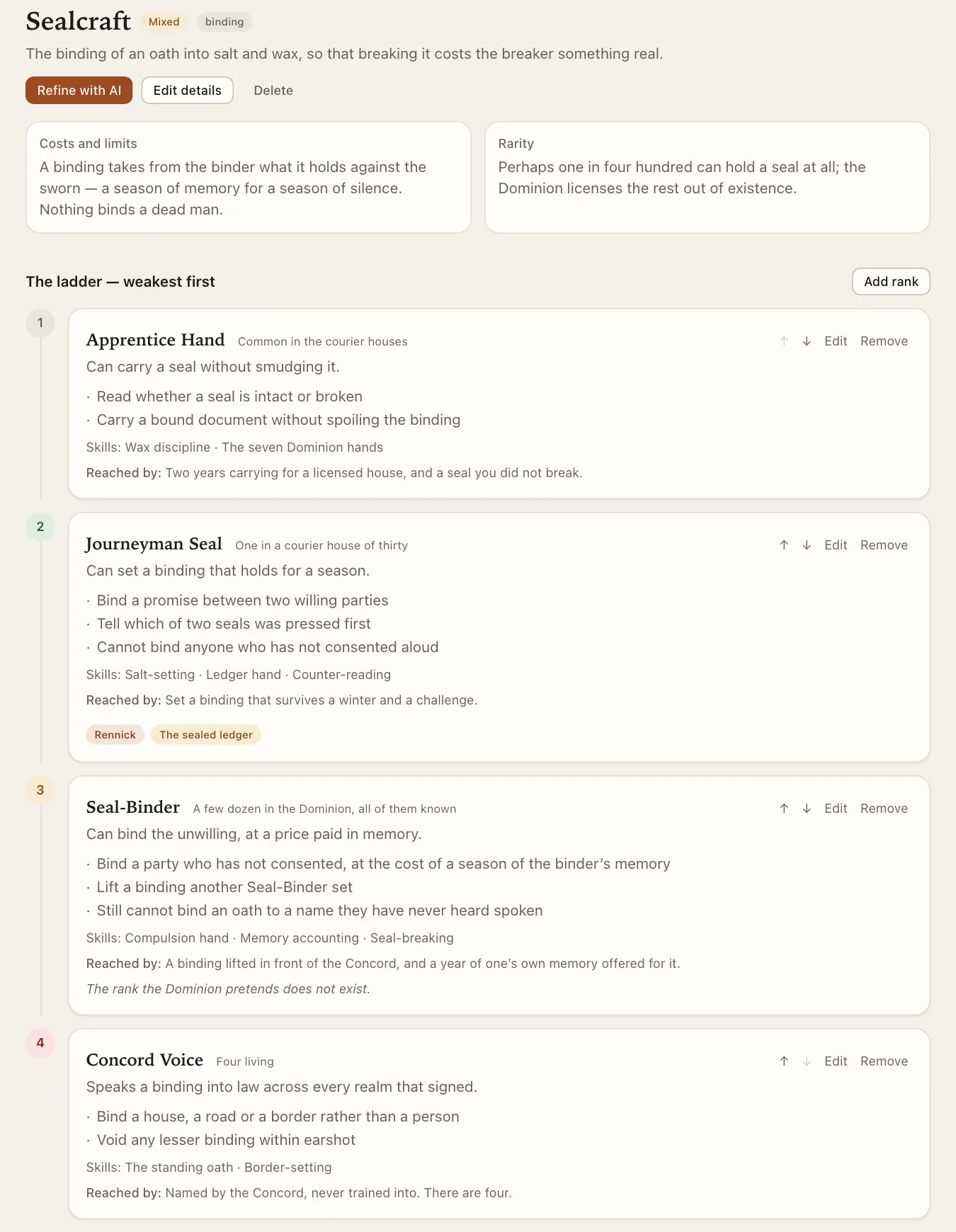
Read the second rung above and you can see the shape of it: bind a promise between two willing parties, tell which of two seals was pressed first — and then, in the same list, cannot bind anyone who has not consented aloud. That last line is doing as much work as the two above it.
Around that ladder sits everything that hangs off it. Professions — the paths that climb it, so a swordsman and an alchemist can share one ladder and diverge in everything else. Techniques, weapons and items that scale, linked from your bible with a line on how each one grows. Power by region, so a border town and an imperial capital are not accidentally the same. And open questions: the things you have deliberately not decided yet, written down as undecided rather than quietly improvised later.
Two kinds of writer, one feature
Here is the thing worth being honest about: not everyone writing in these genres wants to design a power system. Some people are here for the system — the ladder is the book, and the pleasure is in getting the economy of it exactly right. Others are writing about people. The cultivation world is a setting for a story about a brother and a sister, and the magic just needs to behave itself and stay out of the way.
Both are completely legitimate books, so there are two ways in.
Build it by hand. Start from a name and add rungs yourself, filling in as much or as little as you want. Everything is a form; nothing is generated unless you ask. If you already know how your world works, this is the shortest path to having it written down.
Or answer eight questions. What fuels power in your world? How is the ladder named and counted? How does someone climb it? How strong is the top? What does it cost? Who is allowed near it? Who teaches it? How steep is the pyramid?
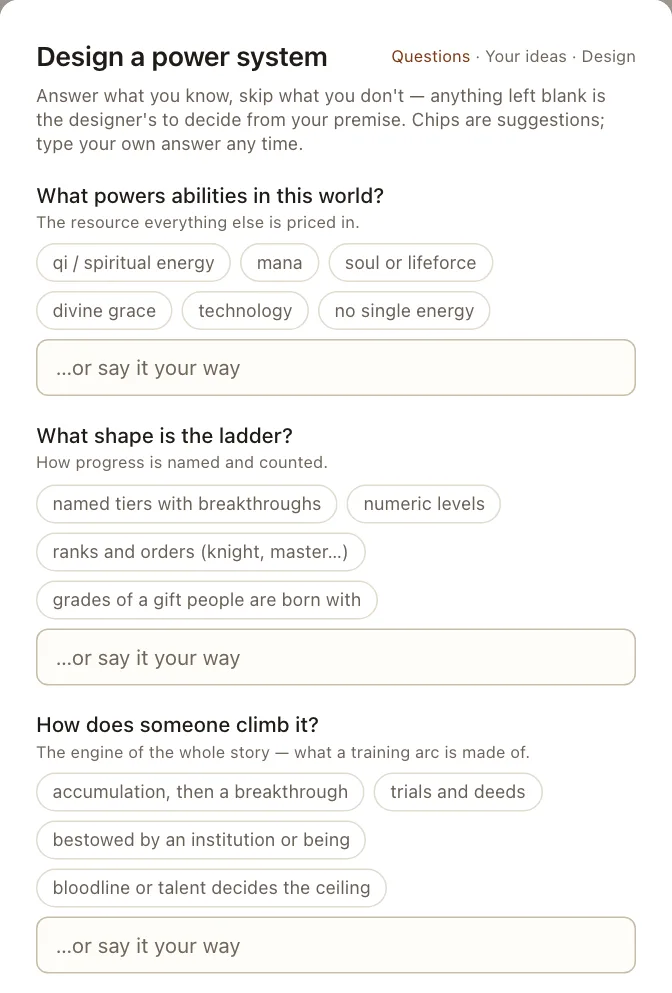
The chips are suggestions, not a menu: type your own answer to any question, skip the ones you have no opinion about, and those choices get made for you from your premise. Anything you write in your own words — "call the peak rank Sky Severing", "breakthroughs need a herb the empire monopolises" — outranks everything else.
What comes back is a full ladder with capabilities, advancement, rarity and professions already filled in. It is a starting position, not a verdict.
Neither road locks you in
The two paths end in the same place, which is the point. A system designed for you is editable in exactly the fields you would have typed yourself — change a rank name, rewrite a capability, delete a profession you dislike. A system you built by hand can be handed to the model with one sentence: add two ranks above Nascent Soul, give every rank a lifespan cost, make the alchemist path non-combat. Only what you asked for changes; the rest of your ladder is left exactly as you wrote it.
Each system carries a small badge saying where it stands — yours, designed, or a mix of both — so you are never guessing which parts you wrote.
Then it does the lifting
Once a system exists, it stops being a document you maintain and starts being something the writing obeys. The ladder travels with every chapter you write, and when a scene actually needs the detail — a breakthrough, a fight across two ranks, the stated limits of a technique — the full system is read before the prose is written. As you accept chapters, ranks your characters reach are recorded back against the ladder, so it stays current without you tending it.
One rule sits underneath all of it: none of this is an instruction to advance anyone. A chapter where nobody breaks through is a perfectly good chapter. The ladder is there to keep the chapters that do honest — so that when your character finally reaches the rank they have been failing at since chapter five, it costs what it cost back then, and it means what it meant.
Open any novel's story bible and the Power tab is waiting — or read the guide first.